
Q&A with Professor Judith McLean, Chair of Monkey Baa
As Chair of Monkey Baa, Professor Judith McLean brings both strategic vision and a deeply personal connection to the transformative power of theatre. In this conversation, she reflects on the moments that have stayed with her during her two years with the company, the vital role of theatre in children’s lives and why access to culture must be seen as essential, not optional. From governance and stewardship to launching the Memory Makers donor circle, she shares her belief that investing in young audiences is ultimately an investment in the future of the country.
Looking back on your first two years at Monkey Baa, what are the most memorable moments?
Judith: It is always the moment just before the story begins.
The house lights dim. The murmur settles. Hundreds of children lean forward in anticipation. And then, together, they enter another world.
Those moments have stayed with me because what unfolds is not simply entertainment. It is connection. It is collective imagination. It is the quiet shaping of empathy.
I have also been profoundly moved by the reach of this company. When Monkey Baa tours to regional and remote communities, the impact is palpable. For many children, this is their first experience of live theatre. And it matters deeply.
Why do you believe theatre for children and young audiences is so important?
Judith: Because childhood is not peripheral to our cultural life; it is foundational to it.
Across Australia, we are seeing increasingly complex wellbeing challenges for children. We are also witnessing a steady decline in cultural participation, particularly for those living outside major cities or experiencing disadvantage. This is frightening for the future of our democracy.
And yet we know the arts are transformative. Live theatre strengthens literacy, nurtures imagination, builds emotional intelligence and fosters belonging. It teaches children how to sit with complexity, how to see through another’s eyes and how to listen.
If we believe in the future of our nation, then we must invest in the imaginative lives of our children.

From your perspective, what makes Monkey Baa’s work distinctive within the sector?
Judith: Monkey Baa is uncompromising in its respect for young audiences.
The work is crafted with artistic rigour and literary depth. It is ambitious, intelligent and emotionally truthful. And it travels across state lines, across geographies and across communities. In the next 2 years, Green Sheep will travel to 80 communities across Australia.
But what feels increasingly important is not only what Monkey Baa creates; it is what it represents.
The company stands as part of a growing recognition that children deserve access to high-quality cultural experiences as a matter of equity, not chance. That this access should not depend on postcode. That theatre for young audiences should be connected to broader conversations about education, prevention and wellbeing.
There is an opportunity emerging to think more cohesively, more ambitiously, about how we support children’s cultural lives nationally.
As Board Chair, what aspects of your role are the most compelling?
Judith: What compels me most is stewardship at a moment of possibility.
The role of Chair is not simply about oversight or compliance, important as those responsibilities are. It is about holding the long view. It is about ensuring that artistic courage is matched by structural strength. That imagination is supported by governance that is clear, ethical and future-focused.
I am deeply drawn to the responsibility of creating the conditions in which others can do their best work, our artists, our executive team and our staff. The Board’s role is to provide stability and vision simultaneously: to protect what has been built and to remain alert to what is emerging.
And what is emerging feels significant.
There is a growing recognition that theatre for children is not peripheral to our cultural ecosystem; it is central to it. As Chair, I am compelled by the opportunity to help position Monkey Baa within a broader, more connected national conversation about children’s access to art, imagination and storytelling.
The most exciting part of leadership, for me, is helping to shape that horizon, ensuring that this remarkable company is not only artistically excellent today, but structurally and strategically ready for what the future asks of it.
That is both a privilege and a profound responsibility.
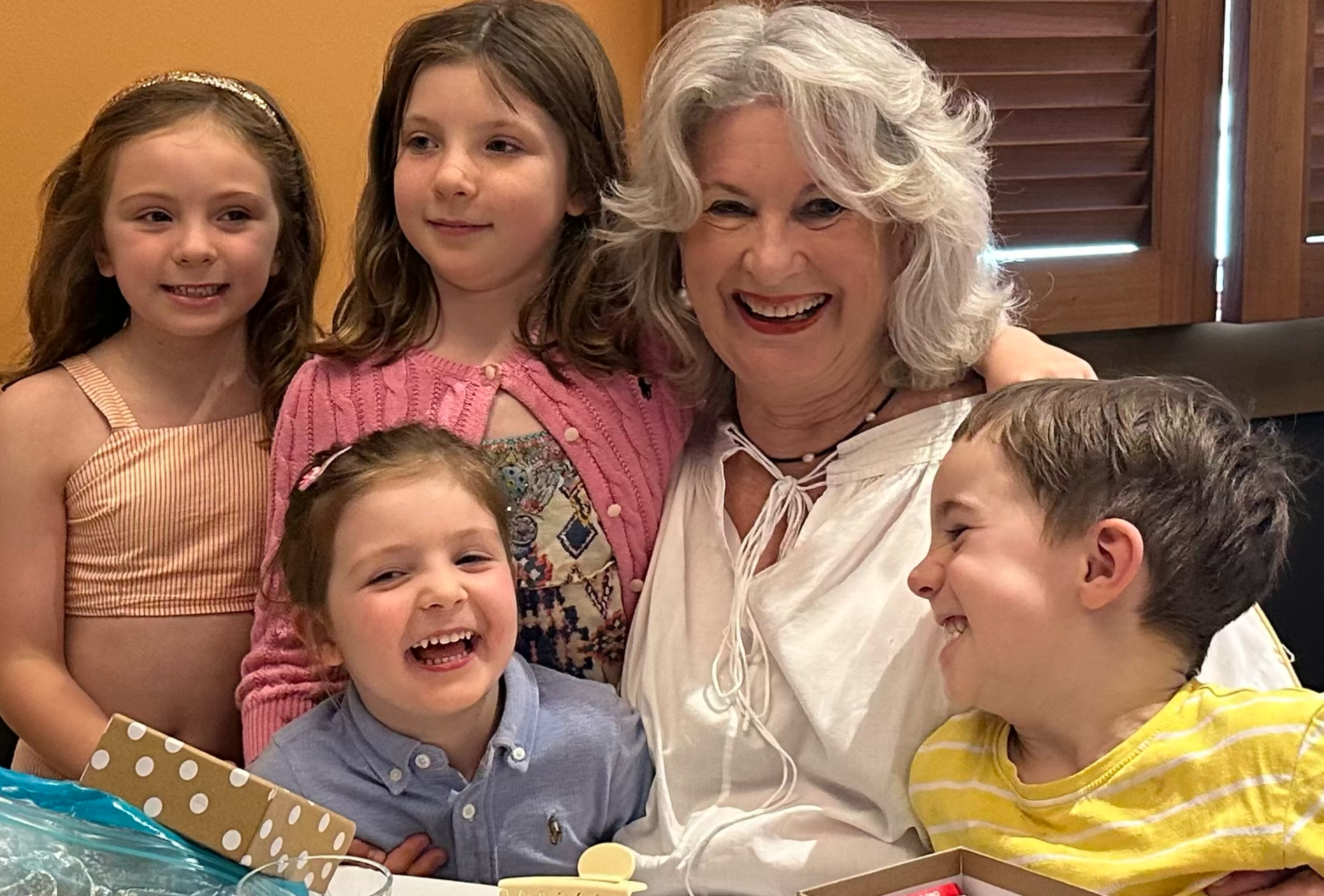
Judith and her grandchildren
You are leading Monkey Baa’s Memory Makers donor circle. Why is Monkey Baa’s Memory Makers Donor Circle an important initiative?
Judith: Memory Makers is built on a simple but powerful idea: that many of us carry a childhood story that shaped us.
The donor circle invites supporters to ensure that today’s children have those same formative experiences. It is philanthropy rooted in legacy and care.
Increasingly, it also feels like a quiet movement, an intergenerational commitment to ensuring that children’s access to art is not fragmented or incidental, but embraced as essential to their growth and wellbeing.
As Board Chair, what excites you most about Monkey Baa’s future?
Judith: What excites me is possibility at scale.
Monkey Baa stands on strong artistic and governance foundations. From that strength comes courage, the courage to imagine more connected pathways, deeper partnerships and a broader national conversation about children’s cultural rights.
There is a sense that we are at a threshold moment. That the time has come to think beyond isolated programs and toward something more joined-up, a more coordinated approach that aligns theatre for children with education, wellbeing and community life.
Not as an afterthought. Not as enrichment. But as core infrastructure for the next generation.
If we can hold that vision collectively, the impact could be profound.
And that is the horizon that inspires me.
Could you share a memorable theatre experience from your own childhood?
Judith: The first professional production I ever saw was with my grandmother. Her name was Mary Kathleen, and she lived until she was 99, so I knew her well into my adult life.
I was about seven years old, sitting beside her in Her Majesty’s Theatre in Brisbane, watching My Fair Lady, with Rex Harrison playing Henry Higgins.
I remember being utterly transfixed.
The scale of it. The costumes. The sweep of the music. The transformation of Eliza Doolittle. I could not believe that people could tell stories in that way, that an entire world could be created before your eyes.
What captivated me most was the idea at the heart of the story: that identity is not fixed. That through language, learning and belief, a person could become something different, perhaps even something more fully themselves.
Although the play is considered old fashioned, even misogynistic, today, the central idea that we are ‘person made’ and can shape-shift to be whoever we want to be has certainly impacted my life in very positive ways.
That afternoon, something shifted for me. Theatre revealed its transformational power.
I left the theatre changed, knowing somehow that I could have the life I wanted.
And I have been in love with that alchemy ever since.


